The war is in words and the wood is the world
Finnegans WakeThe expression The war is in words and the wood is the world condenses Finnegans Wake’s insistence that conflict unfolds not only among people but within language and writing. It joins verbal struggle to material substance: the word is a site of contest, and wood belongs to the same world as the page, the marks upon it, and the stories those marks make possible.
The Phrase in Context
The sentence appears amid a passage that turns a reported death and a near-drowning into competing accounts. A man, rescued from an ornamental lilypond by rodmen, receives a piece of wood from a workman named Mr Whitlock on Umbrella Street. The narration imagines the exchange as a source of powerful words and immediately makes the object’s meaning a public dispute: different listeners variously hear a baton, a hod, a pencil sharpener, or a cup-and-ball. The phrase follows this cascade of rival interpretations, where the wood does not settle the story but gives it another form to circulate in.
The surrounding passage makes the stakes of that circulation explicit. The rescue, the gift, and the words exchanged become matters of report and pub talk; the cradle or casket comparison leaves open whether the story carries the promise of new life or another death. The sentence’s “war” is thus not presented as a straightforward battle scene. It names the contention among versions, sounds, and meanings through which an event becomes a story.
Writing as Material Evidence
Elsewhere, the book treats its central document as a physical object whose substance and damage shape interpretation. It is called a “polyhedron of scripture,” a figure for a text that can be approached from multiple sides and does not resolve into one transparent account. Its writing may bear traces of many personalities, and the narrative entertains the possibility of crimes before any suitable occasion for them has occurred. The document’s marks are not merely a neutral record of events: they help produce the uncertain world readers are asked to reconstruct.
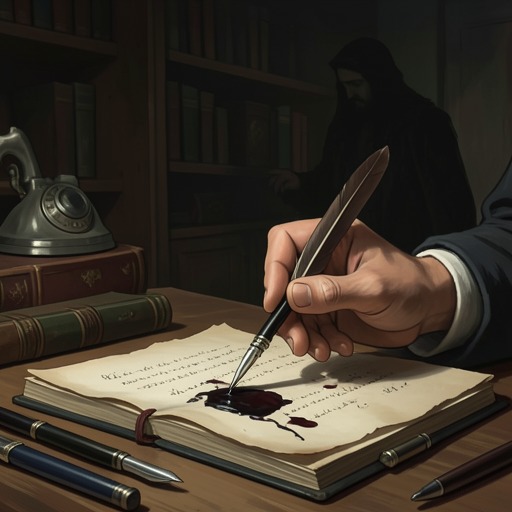
The account of the document’s possible origin refuses to fix a single author or circumstance. It asks whether the writing was made upright or seated, with a quill or a stylus, in a clear or turbid state of mind, and whether scribe and site were visited or interrupted. The questions make authorship inseparable from bodily position, tool, setting, and circumstance. Writing is an act performed in the world, not an immaculate voice outside it.
That material emphasis extends to the text’s irregular lines and its crossings. The page is described as ruled in north-south and west-east directions, first laid out like a checker in lampblack and blackthorn. Its words march, halt, stumble, and resume along those barriers; writing that turns end to end and then reverses direction makes reading resemble a return journey. The visible arrangement becomes part of the meaning rather than a frame that can be ignored.
Marks, Damage, and Competing Readings
The passage scrutinizing the document inventories its unstable features: blocked or bolted circles, incomplete trails, dropped endings, illegible flourishes around Earwicker’s initials, and signs whose interpretation changes with their position. A warning mark indicates that the words following it may be taken in any order. Such details make reading an act of negotiation with the page: order, emphasis, and even the boundaries of a phrase remain unsettled.
A later account gives this principle a particularly concrete form. An unpunctuated document is examined by holding its verso against a lit rush; its recto then reveals that the paper has been pierced by repeated stabs and gashes. The punctures are read as four different forms of stopping, from a simple halt to an emphatic plea to stop. The physical wounds thus become punctuation, and punctuation becomes evidence: interpretation depends on damage made in the paper, not just on words conventionally written across it.
Verbal Conflict and Recirculation
The phrase also fits the book’s broader method of setting languages and voices against one another. Its opening moves through densely transformed names, places, and events; elsewhere, an encounter begins with a speaker testing another through several invented or altered language labels before the two exchange hats and verbs. In another episode, Shaun introduces the Ondt and the Gracehoper as a fable, announcing a story whose verbal form immediately multiplies and distorts familiar sounds. These scenes make language a field of action: identity and understanding emerge through substitutions, mishearings, and exchanges rather than through a stable vocabulary.
Wood, correspondingly, is not simply the opposite of language. The rescued man’s piece of wood is itself drawn into competing names, while the document’s marks retain the pressure of the hand, the tool, and the surface that received them. The expression’s two halves therefore meet in a single material process: words contend over what things mean, and the world persists in the objects and inscriptions through which those meanings are made, damaged, and read again.